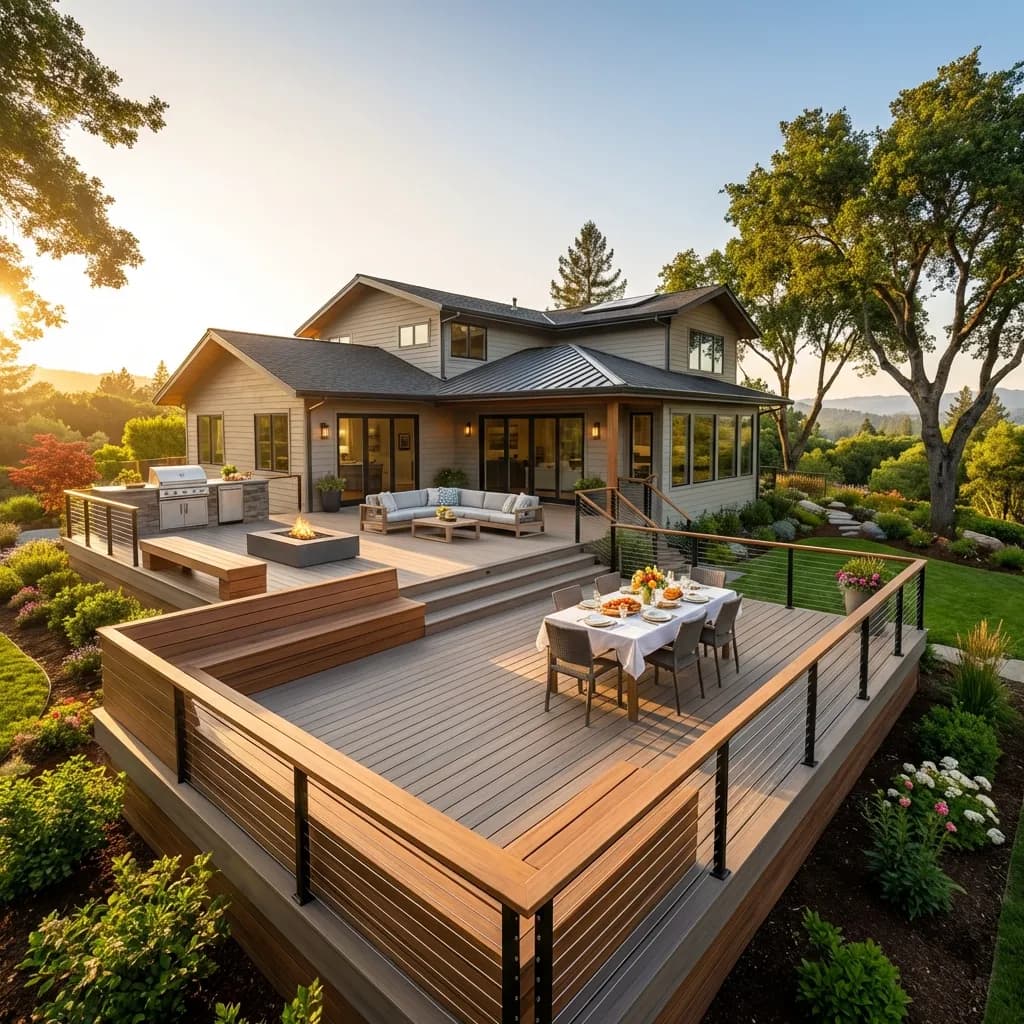
Professional Deck Building Services in Reading, PA
Create the perfect outdoor living space with our custom deck building services. We design and build beautiful, durable decks using composite and natural wood materials. Founded in 2003, VM Power Construction serves Reading and the surrounding Pennsylvania communities with 23+ years of hands-on construction expertise.
Deck Building for Reading Homes
Reading (established 1748, population 95,112) has a distinctive housing mix — from historic Centre Park Historic District properties to newer construction in West Reading. Our deck building approach adapts to each neighborhood's architecture, code requirements, and street-level realities.
Homes across Centre Park Historic District, Wyomissing, West Reading, Mount Penn can have different layouts, materials, and permit requirements. We assess the property and project scope before recommending a deck building plan.
Why Reading Homeowners Choose VM Power Construction
Four Neighborhoods, Four Different Projects
Reading is by far the largest market we serve, and treating it as one market is the mistake that produces estimates nobody can hold to. The same nominal kitchen renovation carries different scope, different risk, and different cost depending on which part of the city or which surrounding borough it sits in.
In the Centre Park Historic District the budget is driven by preservation: original woodwork, plaster, staircases, and window detailing that are the reason the house is worth what it is worth. The work is careful and slow, and the specification decisions are about matching rather than replacing. In Wyomissing, larger lots and larger houses mean bigger kitchens with more cabinetry, more counter run, and higher appliance specification — the cost driver is scale, not delicacy. West Reading's industrial and loft conversions need structural and mechanical questions answered before anything cosmetic is designed, because exposed structure, unconventional spans, and retrofitted services are the substance of the project. Mount Penn and the older city boroughs bring hillside grade, drainage, and pre-1978 lead considerations into most scopes.
We price and schedule against the neighborhood's actual conditions. A Berks County template applied to all four produces a number that is wrong in four different directions.
City Codes Department Versus Borough Offices
Permitting in Reading is genuinely split. Projects inside the city coordinate with the Reading Codes Department on Washington Street. Wyomissing, West Reading, and Mount Penn are separate boroughs with their own permit offices and their own review pace. Pennsylvania's Uniform Construction Code applies statewide but is enforced locally, so which office you file with is a real scheduling variable rather than a formality. Zoning is decided separately from construction permitting and governs setbacks, coverage, and height on any expansion.
Establishing the correct authority is the first thing we do, because in a market where the boundary can run down the middle of a street, filing with the wrong office costs weeks.
Pre-1978 Stock Across Most of the City
Almost all of Centre Park, Mount Penn, and the older city inventory predates 1978, bringing the EPA Renovation, Repair and Painting rule into effect. We hold EPA Lead-Safe RRP certification: sealed containment, HEPA-filtered cleanup, no heat guns or open flame on painted surfaces, and documented verification before the room returns to use. In a dense city block with neighbours sharing a party wall, containment discipline matters beyond your own household.
Neighborhoods and ZIP Codes We Cover
- Centre Park Historic District — preservation-driven scope
- Wyomissing — larger homes, scale-driven budgets
- West Reading — loft and industrial conversions
- Mount Penn — hillside grade and drainage
- Hampden Heights, Oakbrook, Glenside, Riverside
Reading's ZIP codes from 19601 through 19611 are all within our service area.
Supplier Proximity Matters Most in the Largest Market
Our relationships with Reading-area building material, masonry, electrical, and fixture suppliers exist for one reason: when demolition on a Centre Park row home uncovers a structural surprise, the difference between having the right material the next morning and waiting a week is the difference between a schedule and an excuse.
Start Your Reading Project
Call (484) 948-0279 for a free estimate. Tell us the neighborhood on the first call — in Reading that single fact changes the conversation more than the square footage does. Licensed PA HIC #PA158550, fully insured, EPA Lead-Safe RRP certified.
The two decisions that define a deck: framing and connection
Homeowners choose decks by decking material. Decks fail by framing and attachment. Pressure-treated framing sized to span, footings below frost depth, proper joist spacing for the chosen decking, and a correctly flashed and bolted ledger connection are what make a deck last and stay safe. Decking is the part you see; framing is the part that holds you up.
The ledger is the highest-consequence detail on the whole build
Most catastrophic deck collapses are ledger failures, and most ledger failures come from two causes: attachment with nails or undersized lag screws instead of properly sized and spaced through-bolts or structural screws, and missing flashing that lets water sit against the rim joist until it rots. That connection must be flashed so water is directed out and away, and fastened to a pattern the load actually requires. A deck can look immaculate and still be attached to a house by a rotting board.
Footings, frost, and clay
Footings must bear below the local frost line, on undisturbed soil, sized for the load they carry. In clay-heavy soils, frost heave and seasonal movement are real, and a footing set too shallow will lift and drop the structure through the seasons until connections loosen and the frame racks. Backfill around footings should be properly compacted rather than loose spoil.
Decking materials, honestly compared
Pressure-treated is the lowest cost and needs cleaning and re-sealing on a regular cycle to stay presentable. Composite and PVC cost substantially more up front and eliminate sealing, though composite can get hot underfoot in direct sun and lower-grade boards can fade unevenly. PVC is the most stable and the most expensive. There is no maintenance-free option; there are only different maintenance tradeoffs, and the honest comparison is total cost over fifteen years rather than the price of the boards.
Permits, railings, and stairs
Deck permitting depends on height above grade and jurisdiction, and New Jersey is materially stricter than Pennsylvania on when a permit is required. Railing height, baluster spacing, and graspable handrail profiles are code-specified, and stair geometry — consistent rise and run within tight tolerance — is both a code item and the most common inspection failure on otherwise good work. Guard and railing assemblies also have to resist real lateral load, which means the post connections matter as much as the rail.
Our Deck Building Services Include:
- Composite Decking
- Pressure-Treated Wood
- Custom Design
- Built-in Seating & Planters
- Railing Systems
- Permit Management
Why Choose VM Power Construction for Deck Building in Reading?
As a licensed and insured contractor serving Reading, PA, we understand the unique needs of local homeowners. Our team of experienced professionals is committed to delivering exceptional results on every project.
Benefits of Working With Us:
- Extend your living space
- Increase home value
- Low-maintenance options
- Custom designs for any yard
Serving Reading and Surrounding Areas
VM Power Construction proudly serves Reading and nearby communities throughout the Lehigh Valley and Pennsylvania. Whether you're looking for a simple update or a complete transformation, our team has the expertise to bring your vision to life.
Contact us today for a free estimate on your deck building project in Reading, PA.