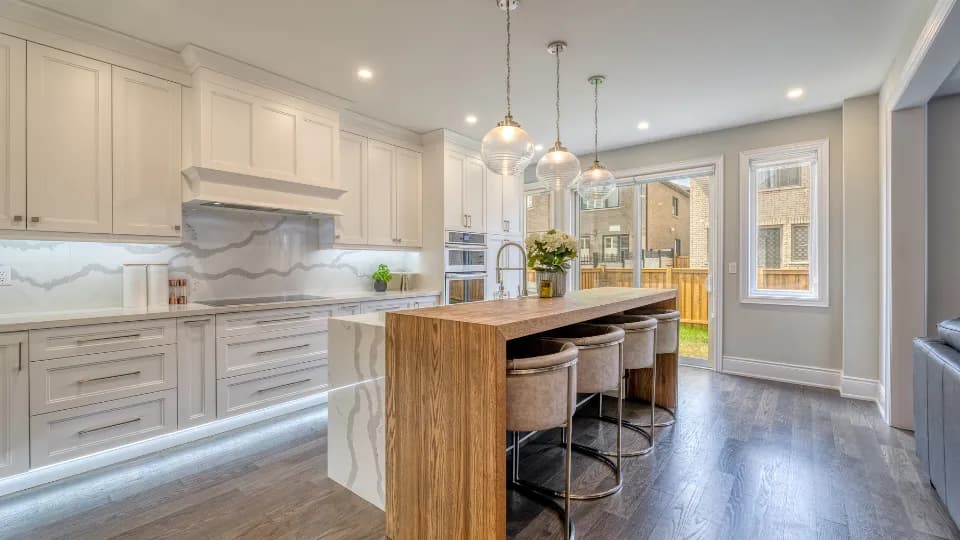
Professional Kitchen Remodeling Services in Phillipsburg, NJ
Transform your kitchen into a stunning, functional space with our expert kitchen remodeling services. We handle everything from custom cabinetry and countertop installation to complete kitchen renovations. Founded in 2003, VM Power Construction serves Phillipsburg and the surrounding New Jersey communities with 23+ years of hands-on construction expertise.
Kitchen Remodeling for Phillipsburg Homes
Phillipsburg (established 1861, population 15,249) has a distinctive housing mix — from historic Downtown properties to newer construction in Delaware Heights. Our kitchen remodeling approach adapts to each neighborhood's architecture, code requirements, and street-level realities.
Homes across Downtown, Hillcrest / Andover Heights, Delaware Heights, South Phillipsburg can have different layouts, materials, and permit requirements. We assess the property and project scope before recommending a kitchen remodeling plan.
Why Phillipsburg Homeowners Choose VM Power Construction
One River, Two Completely Different Rulebooks
Phillipsburg sits directly across the Delaware from Easton, and the five-minute drive between them crosses a real regulatory boundary. New Jersey requires construction permits for nearly all decks, additions, and structural work regardless of size. Pennsylvania's thresholds are more permissive — a low-elevation deck that needs no permit in Easton needs a full permit in Phillipsburg.
We hold licenses on both sides, which means we do not have to guess which rulebook applies or learn it on your project. Phillipsburg permits are issued under New Jersey's statewide Uniform Construction Code through the Town construction office on Corliss Avenue, split into building, electrical, plumbing, and fire protection subcodes, each with its own review and its own inspections at defined stages. Warren County becomes involved on larger structural work. Zoning is a separate track and governs setbacks and coverage.
For homeowners who got a quote from a Pennsylvania contractor and are wondering why our scope includes permits theirs did not, this is usually the answer.
Delaware Valley Moisture Is Not Optional to Design For
Phillipsburg shares Easton's climate load: river-valley humidity, a hard freeze-thaw cycle, and seasonal high water. Properties nearer the river and along Lopatcong Creek carry moisture priorities that homes a few miles inland simply do not have.
That means below-grade and foundation work here starts with water management as the design, not as an add-on. Exterior grading corrected away from the structure, downspout discharge carried well clear, French drains where the site calls for them, a proper vapor barrier against the foundation wall, and engineered backfill rather than whatever came out of the excavation. Freeze-thaw makes footing depth and drainage detailing matter for patios, steps, and deck footings, because water that sits and freezes will move masonry regardless of how well it was laid. A finished basement built without resolving these first is a remediation project waiting on a wet spring.
The Borough Core Is Overwhelmingly Pre-1978
Most of downtown Phillipsburg and the older residential streets predate 1978, bringing the EPA Renovation, Repair and Painting rule into effect on nearly every project in the core. We are EPA Lead-Safe RRP certified: sealed containment, HEPA-filtered cleanup, no high-heat or open-flame paint removal, and verification before the space returns to use.
Neighborhoods and ZIP Codes We Cover
- Downtown and Union Square — pre-1978 throughout
- Hillcrest and Andover Heights
- Delaware Heights
- South Phillipsburg — river proximity, moisture priority
- Lopatcong and Pohatcong borders
Phillipsburg's 08865 ZIP code is fully inside our service area.
Cross-River Positioning
Easton is five minutes away, and Lopatcong, Pohatcong, Alpha, and Greenwich Township are all short runs. Working both sides of the river is why crews and materials stay on schedule whether the job is in town or out in the surrounding townships — and why we can compare what a project costs under each state's requirements without speculating.
Start Your Phillipsburg Project
Call (484) 948-0279 for a free estimate. If you are comparing quotes with a Pennsylvania contractor, ask both of us what permits the job needs — the answers should differ, and the reason matters. Licensed NJ HIC #13VH11744800 and PA HIC #PA158550, fully insured, EPA Lead-Safe RRP certified.
What actually drives a kitchen remodel's cost and timeline
Two things decide a kitchen budget more than finish selection does: whether plumbing and gas move, and whether a wall comes out. Keeping the sink, range, and refrigerator in place while replacing cabinetry, counters, and flooring is the least expensive scope. Relocating the sink means new supply and waste runs with correct fall on the drain. Removing a wall means proving what it carries before anything else is designed.
Cabinetry is the long lead item, not the countertop
Semi-custom and custom cabinetry commonly runs six to ten weeks from approved drawings, and it is the item that sets the whole schedule. Ordering before the field measurement is final is how a kitchen ends up with filler strips where a door should be. We measure the room as built after demolition exposes the framing, because pre-1980 walls are rarely plumb or square and a cabinet run designed to the drawing rather than the wall will not close correctly. Countertops are templated after cabinets are set, which is a fixed one-to-two week gap that no amount of scheduling pressure removes.
The permit subcodes a kitchen usually triggers
A kitchen renovation is rarely one permit. Moving or adding circuits pulls the electrical subcode; relocating the sink or adding a pot filler pulls plumbing; a gas range connection or a new hood duct through the envelope can pull mechanical and gas. Each is reviewed and inspected on its own, and rough inspections have to happen before walls close. That is why the drywall date depends on the inspection date and not the reverse.
Electrical capacity is the most common surprise
Kitchens built before roughly 1990 were not wired for today's load. An induction range, wall oven, dishwasher, microwave, disposal, and a beverage refrigerator represent far more demand than the original branch circuits and panel were designed for. Current code expectations around dedicated appliance circuits, small-appliance branch circuits, and GFCI/AFCI protection mean most older kitchens need real electrical work, and sometimes a service upgrade. We identify that during estimating rather than presenting it as a change order in week three.
Where homeowners regret cutting
The items people wish they had not economised on are consistent: undersized ventilation for the range, drawer hardware that fails under load, and a layout compromised to save a plumbing move. The items that rarely justify their cost are ultra-premium appliance packages in a kitchen whose layout was never fixed, and stone upgrades in a room with poor lighting. Fix the layout, the light, and the ventilation first — those are what the room feels like every day.
Our Kitchen Remodeling Services Include:
- Custom Cabinet Design & Installation
- Granite & Quartz Countertops
- Kitchen Island Construction
- Appliance Integration
- Lighting Design
- Flooring Installation
Why Choose VM Power Construction for Kitchen Remodeling in Phillipsburg?
As a licensed and insured contractor serving Phillipsburg, NJ, we understand the unique needs of local homeowners. Our team of experienced professionals is committed to delivering exceptional results on every project.
Benefits of Working With Us:
- Increase your home's value by 10-15%
- Improved functionality and storage
- Energy-efficient appliance upgrades
- Modern aesthetics that match your style
Serving Phillipsburg and Surrounding Areas
VM Power Construction proudly serves Phillipsburg and nearby communities throughout New Jersey. Whether you're looking for a simple update or a complete transformation, our team has the expertise to bring your vision to life.
Contact us today for a free estimate on your kitchen remodeling project in Phillipsburg, NJ.